How to choose high-impact activewear for support and style
You’re three minutes into a HIIT circuit, jumping, sprinting, changing direction fast, and all you can think about is the way your sports bra is digging in or your leggings are sliding down. That distraction costs you focus, form and results. Choosing the right activewear for high-impact training is not about fashion first. It is about finding gear that moves with you, protects you from discomfort, and still makes you feel confident walking into any gym or outdoor session. This article covers every decision you need to make, from sports bra selection to bottoms, common mistakes to avoid, and how to verify your fit before you commit.
Table of Contents
- What to look for in high-impact activewear
- Choosing the right sports bra: support, fit and features
- Selecting bottoms: shorts, leggings and combatting chafe
- Mistakes to avoid when choosing high-impact activewear
- Our take: why fit and flexibility often beat maximum support
- Step up your game with the right activewear
- Frequently asked questions
Key Takeaways
| Point | Details |
|---|---|
| Support is crucial | Choose bras and bottoms that minimise movement and deliver comfort during high-impact activities. |
| Fabric matters | Moisture-wicking, compression fabrics with high breathability prevent chafing and overheating. |
| Fit comes first | Proper fit—especially adjustability and the right size—is more important than labels or brand names. |
| Avoid common mistakes | Don’t choose activewear based solely on appearance or support; consider specific high-impact demands. |
| Test before you buy | Move around in potential purchases to ensure they stay comfortable in real workout conditions. |
What to look for in high-impact activewear
High-impact activity covers anything that involves repeated, forceful movement. Think HIIT, running, jump rope, plyometrics, boxing circuits and aerobics. These workouts create significant bounce, friction and sweat, which means your activewear needs to work considerably harder than it would for yoga or Pilates.
The core requirements for high-impact gear come down to five things: support, fit, moisture management, minimal chafing and style. None of these is optional. A bra that ticks four out of five will still let you down when it matters most.
Here are the must-check features before you buy:
- Material type: Look for polyester, nylon or spandex blends with moisture-wicking properties. Avoid cotton, which holds sweat and becomes heavy.
- Seam construction: Flatlock seams sit flush against the skin and dramatically reduce chafing during repetitive movement.
- Compression level: Medium to high compression keeps everything in place and reduces muscle fatigue over longer sessions.
- Secure fit: Adjustable straps, wide underbands and snug waistbands prevent shifting mid-workout.
- Breathability: Mesh panels or perforated zones allow heat to escape, keeping your core temperature regulated.
Research confirms that high-impact sports bras reduce vertical breast displacement by approximately 60% compared to wearing no bra, which is the benchmark for effective support without causing excessive discomfort.
| Feature | Why it matters for high impact |
|---|---|
| Moisture-wicking fabric | Keeps skin dry, reduces friction and prevents rash |
| Flatlock seams | Eliminates chafing during repetitive, high-speed movement |
| Compression panels | Minimises bounce and supports muscle alignment |
| Wide underband | Distributes weight evenly and prevents bra riding up |
| Adjustable straps | Allows personalised fit across different body shapes |
| Breathable mesh zones | Regulates temperature during intense cardio |
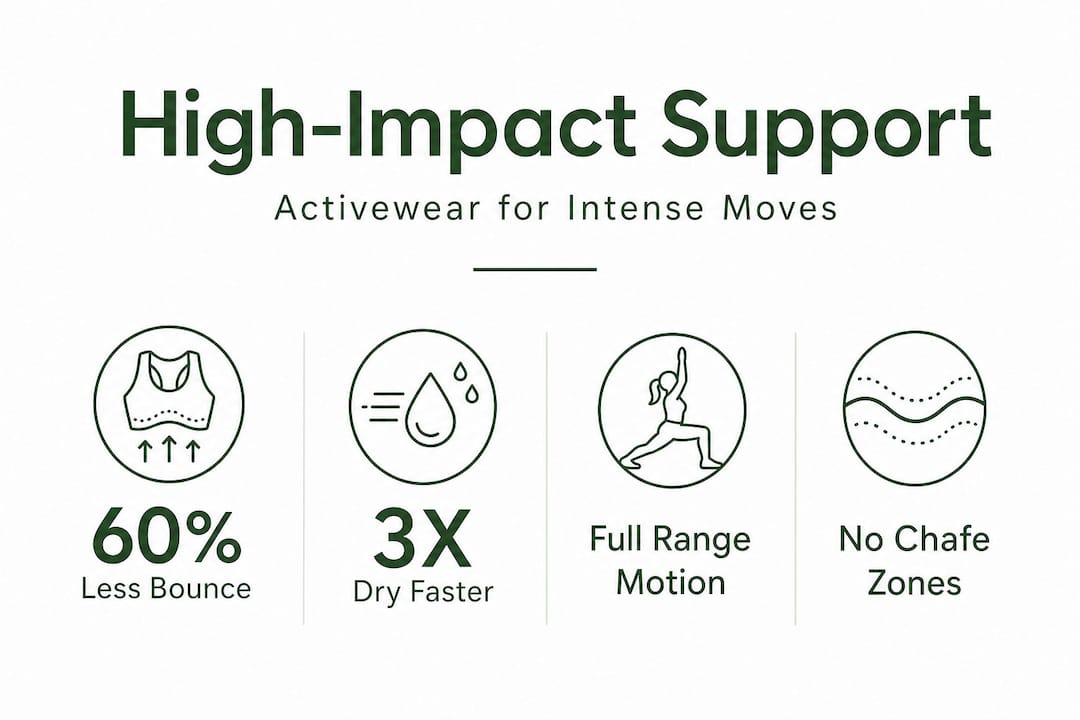
Pro Tip: When shopping for high-impact gear, prioritise compression level and fabric quality above everything else. A well-constructed fabric in the right compression zone will outperform a flashy design with poor construction every single time.
Choosing the right sports bra: support, fit and features
The sports bra is the single most important piece of activewear for any high-impact session. Getting it wrong means discomfort, distraction and potential long-term tissue strain. Getting it right means you can push harder, move freely and stay focused.
“High-impact sports bras reduce vertical breast displacement by approximately 60% compared to no bra, sufficient for effective support without excessive discomfort.” — Biomechanics of breast support for active women
That 60% figure is your baseline. If a bra cannot get close to that level of reduction during a jump test, it is not doing its job for high-impact training.
How to fit a sports bra correctly
- Measure your band size first. Wrap a tape measure around your ribcage, directly under your bust. This number, rounded to the nearest even number, is your band size.
- Measure your bust. Measure around the fullest part of your chest. The difference between bust and band gives you your cup size.
- Try the jump test. Put the bra on, then jump in place for 30 seconds. If you feel significant movement or the bra shifts, it is not supportive enough.
- Check the band. It should sit level across your back and you should only be able to fit two fingers underneath it. If it rides up, go down a band size.
- Assess the straps. They should stay put without digging in. If you are constantly adjusting them, the style or size is wrong.
Research into bra parameters for support shows that high-elastic-modulus cups and shoulder straps, polyester underbands, higher cup heights, shorter straps and smaller underband circumferences all contribute to reducing vertical breast motion. These are the construction details worth checking on the product description before you purchase.
| Bra type | Support level | Adjustability | Best for |
|---|---|---|---|
| Compression | High | Low | A to C cup, HIIT, running |
| Encapsulation | Very high | Medium | D cup and above, all high-impact |
| Combination | Very high | High | All cup sizes, long-duration sessions |
For larger busts (D cup and above), encapsulation bras are preferred over pure compression styles because they support each breast individually rather than flattening everything against the chest. Compression alone can create discomfort and uneven pressure for larger cup sizes.
Pro Tip: Never try to compensate for a poorly fitting bra by tightening the straps. Straps are designed for positioning, not primary support. The band does the heavy lifting. If you need more support, choose a different bra style rather than cranking the straps tighter.
Selecting bottoms: shorts, leggings and combatting chafe
Once your support is sorted up top, it is time to nail the perfect bottoms for your chosen activity. The wrong choice here can cause chafing, overheating, restricted movement or constant readjusting, all of which pull your attention away from performance.

The shorts versus leggings debate comes down to three main factors: the activity, the climate and your personal preference for coverage and compression.
Shorts offer superior breathability and are ideal for hot weather, high-sweat sessions and activities where leg freedom is essential, like box jumps or sprint intervals. The key is inseam length. High-impact shorts should have a 2.5 to 5 inch inseam, moisture-wicking fabric and compression lining to prevent inner-thigh chafing. Anything shorter risks riding up, and anything longer can restrict stride length.
Leggings provide full coverage, higher compression across the thighs and better warmth for cooler conditions or early morning outdoor training. They also tend to stay in place better during floor-based exercises like burpees or mountain climbers.
Here are the signs your bottoms are working correctly for high-impact training:
- No inner-thigh chafing after a full session
- Waistband stays in place during jumps, squats and direction changes
- No visible sweat patches or fabric saturation after 30 minutes
- Full range of motion without pulling or restriction at the hip crease
- Fabric does not become see-through when stretched during a lunge or squat
| Scenario | Best choice | Key feature to prioritise |
|---|---|---|
| Summer HIIT outdoors | Shorts | Moisture-wicking, compression liner |
| Winter running | Full-length leggings | Thermal fabric, high waistband |
| Indoor gym circuits | 7/8 leggings or shorts | Flatlock seams, squat-proof fabric |
| Jump rope or plyometrics | Shorts | Short inseam, secure waistband |
| Long-distance running | Leggings or shorts | Anti-chafe seams, breathability |
Pro Tip: For summer sessions or any workout where you are sweating heavily, choose shorts over leggings. The extra breathability makes a measurable difference to your comfort and body temperature regulation, which directly affects how long and how hard you can train.
Mistakes to avoid when choosing high-impact activewear
Even with all the right information, it is easy to make decisions that cost you comfort or money. These are the most common mistakes active women make when selecting high-impact gear, and how to fix each one.
-
Choosing based on looks alone. A bold print or flattering silhouette is great, but if the fabric does not wick moisture or the seams are raised and rough, you will feel it within the first ten minutes of training. Always check the fabric composition and seam construction before adding to cart.
-
Over-tightening straps for extra support. As covered earlier, straps are not the primary support structure of a sports bra. Tightening them beyond their intended range causes shoulder pain, nerve compression and uneven pressure. Choose the right bra style for your cup size instead.
-
Ignoring activity-specific movement patterns. Not all high-impact activities create the same type of breast motion. High-support bras are best for HIIT and running, but tactical or long-duration activities often require adjustability and versatility beyond simple bounce reduction. A bra that is perfect for a 20-minute HIIT class might become uncomfortable during a two-hour trail run.
-
Dismissing adjustable features. Adjustable straps, hook-and-eye closures and removable padding give you flexibility across different body changes and activity types. Fixed-design bras can become redundant quickly if your training or body changes.
-
Not testing moisture-wicking claims in real conditions. Many garments claim moisture-wicking properties, but the quality varies enormously. If possible, test the fabric by splashing a small amount of water on it. Quality moisture-wicking fabric pulls liquid away from the surface immediately rather than absorbing it.
“Breast motion varies by activity: running emphasises medial-lateral movement at 1.5 times the superior-inferior direction; jumping rope produces superior-inferior motion at five times the rate; high knees produce a more balanced pattern.” — Exploration of breast motion under different activities
This is a critical insight. The direction of breast motion changes depending on what you are doing. Running creates more side-to-side movement, while jump rope creates more up-and-down movement. Your bra needs to address the dominant motion pattern of your primary activity. A bra that controls vertical bounce brilliantly might not offer enough lateral stability for a running-heavy programme.
Our take: why fit and flexibility often beat maximum support
Here is something the technical specs and research papers will not tell you: maximum support is not always the right goal. We have worked with hundreds of active women across all training styles, and the feedback is consistent. The bra with the highest support rating on paper is not always the one that delivers the best performance in real life.
Overly rigid, maximum-support bras can restrict breathing depth during intense cardio. They can limit shoulder mobility during overhead movements. They can create pressure points that become genuinely painful over a 60-minute session. The “best” bra by technical standards becomes the worst bra for your body if it compromises your movement quality.
The same logic applies to bottoms. Ultra-high-compression leggings sound ideal on paper, but if they restrict your hip flexors during a squat or make you feel like you are wearing a tourniquet, they are actively working against you.
What we have learned is this: the right activewear is the gear that disappears. You stop thinking about it. You stop adjusting it. You stop noticing it. That is when you know you have found the right fit. A changing-room squat test, a few jumping jacks and a quick overhead reach will tell you more about a piece of activewear than any product description.
Flexibility and adjustability are underrated. A combination sports bra with adjustable straps and a hook closure that you can tweak between sessions will serve you better over time than a fixed-design bra with a higher support rating that fits perfectly today but becomes uncomfortable in six months. Invest in gear that adapts to you.
Step up your game with the right activewear
Ready to take the leap and upgrade your activewear for your next high-impact session? Everything you have just read comes down to one practical step: choosing gear that is built specifically for the demands of your training, not just styled to look the part.
At Skoki Maev, we design premium high-impact activewear for active women who refuse to compromise on performance or style. From high-support sports bras with adjustable encapsulation to compression leggings and breathable shorts engineered for real movement, every piece is built around how you actually train. Browse our curated range, use our fit guides, and find the activewear that genuinely works as hard as you do.
Frequently asked questions
How do I know if a sports bra is supportive enough for high impact?
A supportive bra should reduce bounce by 60% and feel completely stable during jumping, sprinting or sudden directional changes. If you feel significant movement or need to hold yourself during exercise, the bra is not supportive enough.
Should I choose shorts or leggings for HIIT sessions?
Shorts with 2.5 to 5 inch inseams, moisture-wicking fabrics and compression lining are usually the best choice for HIIT, particularly in warmer conditions where breathability makes a real difference to comfort and endurance.
How does breast motion change with different high-impact exercises?
Breast movement patterns vary significantly depending on the activity. Running emphasises side-to-side motion while jumping rope creates greater up-and-down motion, which means your bra needs to match the dominant movement direction of your primary training style.
What is the difference between compression, encapsulation and combination sports bras?
Compression bras press both breasts against the chest wall for general support, encapsulation styles cup and support each breast individually for superior control, and combination bras use both methods. For D cup and above, encapsulation or combination styles are strongly recommended over pure compression.
Are expensive activewear brands always better for high-impact activities?
Not always. The best activewear matches your specific activity, body shape and fit requirements rather than price point alone. Focus on fabric composition, seam construction and support structure rather than brand name or cost when making your decision.